

CBT anxiety crisis is one of the most critical challenges facing Nigerian educators as we approach the 2026 JAMB exams. Consider the story of Ada, a student who has consistently topped her class since JSS1. She is the kind of student who explains complex Redox reactions to her peers and solves Further Mathematics problems for fun. However, during a recent CBT mock exam, the atmosphere changed. As the red digital timer on the top corner of the screen began its relentless countdown, Ada froze. Her fingers hovered over the mouse, trembling. She knew the answers, but she couldn’t remember where to click to “Mark for Review.” She spent six minutes panicked by a single Physics calculation, and by the time she regained her composure, the system had logged her out.
Ada’s results were shockingly low, a heartbreaking contrast to her high intelligence. Her story is not unique; it is a textbook example of how a lack of digital familiarity can sabotage academic excellence. We must acknowledge that brilliant students often underperform not because they lack knowledge, but because they lack “screen stamina.” In the 2026 exam landscape, reading textbooks is no longer enough. To ensure your students succeed, you must bridge the gap between their cognitive ability and their digital execution.
The Anatomy of the Crisis: Why High IQ Isn’t Enough
Many top students fail CBT exams because they panic in front of the screen for very specific reasons: timer pressure, screen confusion, and the fear of making irreversible technical mistakes. In a traditional paper-based exam, a student can see all the questions at once, providing a sense of control. In a Computer Based Test (CBT), the “one-at-a-time” question format can create a feeling of claustrophobia.
Consequently, when the interface feels strange, even the brightest minds can go into “fight or flight” mode. This physiological response shuts down the prefrontal cortex, the part of the brain responsible for complex problem-solving. This is why a student who can solve a quadratic equation in their sleep suddenly forgets the multiplication table during the exam. Overcoming the CBT anxiety crisis requires us to treat the computer interface as a subject that must be mastered, just like English or Biology.
The Reality of Digital Friction: How Your Preparation Might Be Falling Short
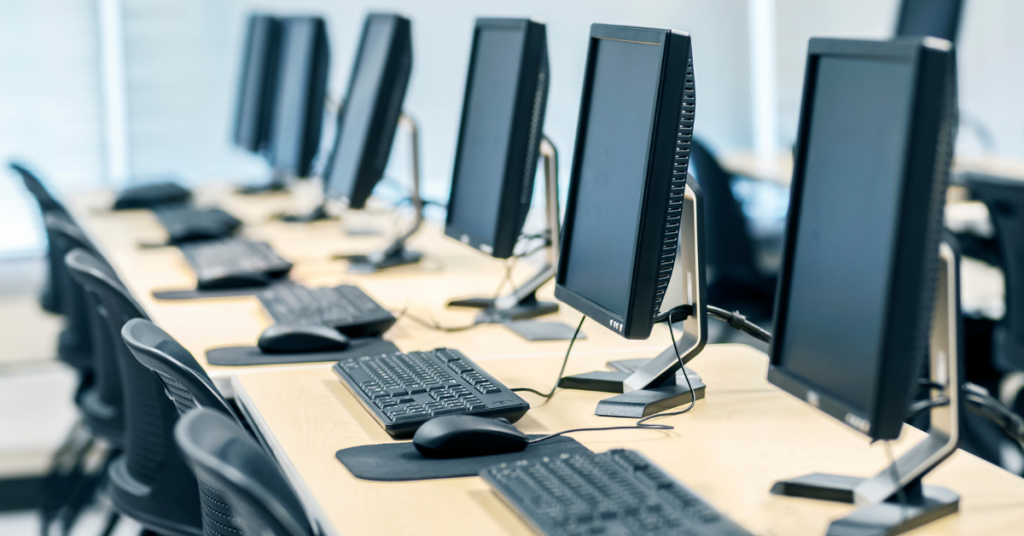
You prepared him well. He revised his notes until he could recite them without error. He practised thousands of past questions in a printed booklet. But in the CBT hall, he struggled to move between questions. He kept looking for where to click “Next.” He wasted precious seconds figuring out the scroll bar. By the time he settled down to actually think about the questions, anxiety had already taken over his nervous system.
This “digital friction” is one of the silent killers of JAMB scores. The exam is digital, which means students need to be confident with navigation, timing, and reviewing answers on a screen. If the first time a student interacts with a JAMB-style interface is on the day of the UTME, they are already at a disadvantage. Overcoming the CBT anxiety crisis starts with the realisation that the medium is part of the test. If the student is fighting the computer, they cannot focus on fighting the questions.
Strategic Solutions for Overcoming CBT Anxiety Crisis in Your School
As a school owner or teacher, your role is to move your students from “Revision” to “Simulation.” Confidence grows from repetition, and speed improves with familiarity. Your students’ anxiety drops significantly when the exam environment feels normal rather than hostile.
Using the EdSofta UTME App, you can provide your students with a structured CBT simulation that mirrors the real JAMB interface. This is about practising the exact experience they will encounter in April. When a student has taken twenty full-length mocks on a platform that looks, feels, and “ticks” like the real thing, the “Exam Hall Freeze” becomes a thing of the past. They learn the “Skip and Return” culture, they master the on-screen calculator, and they learn to treat the timer as a guide rather than a threat.
Mastering the Interface: The EdSofta Advantage

The goal is to provide your students with high-fidelity simulations before the real test. The EdSofta App is specifically engineered to replicate the official JAMB Eight-Key interface used for the UTME. This means your students are building muscle memory. They won’t be “figuring out the screen” on exam day; they will be focused entirely on their subject matter.
Furthermore, the app works 100% offline. This is vital because it allows for consistent practice in the classroom or at home without the distraction of internet lag or data costs. Teachers can set up weekly CBT routines, transforming the computer lab from a place of “IT lessons” into a “Score-Boosting Factory.” By the time the actual UTME window opens, your students will walk into the hall with the calm of a pilot entering a cockpit they have flown in a thousand times before.
Action Plan: Moving from Panic to Performance
To effectively implement a strategy for overcoming the CBT anxiety crisis, school owners should adopt the following action-oriented steps:
- Weekly Simulations: Dedicate every Friday to a “Full-Dress Mock” using the EdSofta App. No phones, no notes, just the student and the screen.
- The 40-Second Drill: Use the app to run speed drills. Can the students finish 20 English questions in 15 minutes? Building this “speed-buffer” reduces anxiety.
- Review the Analytics: Use EdSofta’s diagnostic tools to show students where they lost time. Did they spend too long on one Math question? Seeing the data helps them adjust their strategy.
Conclusion: Preparing Students for the Digital Reality
Ultimately, the difference between a 190 and a 290 score often comes down to emotional regulation and digital fluency. Ada didn’t need more Physics textbooks; she needed more hours behind a simulated screen. By prioritising the digital experience, you are giving your students the psychological edge they need to succeed.
Overcoming the CBT anxiety crisis is possible when we stop treating the computer as a neutral tool and start treating it as a core component of exam preparation. With the right routine and the right technology, you can ensure that your brilliant students finally get the results their intelligence deserves.